


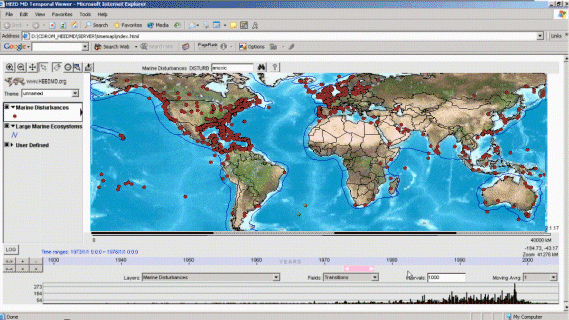
HEED MD Staff Collect metadata to:-> Recoup prior funded investment HEED MD Methods include: -> Mining of the thousands of scholarly publications and government documents relevant to disturbance information for data discovery. -> Use of canonical semantic keyword associations and neural networks to assist in data recovery. HEED MD Staff Also: -> Facilitate training workshops designed to build research consensus and inter-institutional coordination. -> Develop virtual scientific networks to consolidate observational data and maintain an expert review systems to reconcile disturbance, scale, and quality issues. -> Consider the use of mass media reports and observational contributions from voluntary observers and the general public to fill gaps in custodial records. |
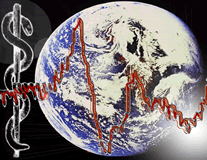
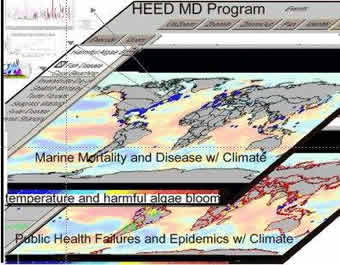
Tracking Harmful Species / Human Health / MMEDs / Disturbance / Wildlife Epidemiology / Zoonoses / Pandemics / Range Changes to develop indices of ecological health |
HEED Approach
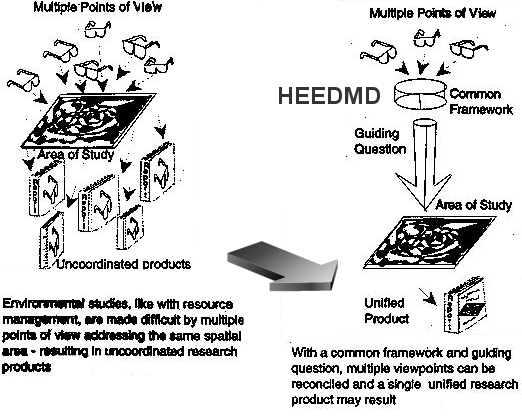
From the perspective of a researcher studying a
particular patch of land or seascape, collecting prior research products
representing location, time and tracking down other's methods, remains
the greatest obstacle in environmental characterization. --- Prior
observations form the context for ALL contemporary observation. Recovery
of place specific disturbance regimes from the re-assembled information
by-products of past studies is possible. One strategy is to focus on
meta-data (data about data) and to extract this information from
bibliographic archives using keyword searches. This can then direct
efforts toward appropriate acquisition of the primary data itself. The
literature/metadata mining strategy is expedited through an
interdisciplinary process outlined here. The process is designed to be
expedient, cost effective, useful to resource managers, and ultimately
advances science by helping researchers generate hypotheses.